
React Native UI Kit Sample App

Reference implementation of React Native UI Kit and APNs Push Notification setup.

What this guide covers

  • CometChat Dashboard setup (enable push, add APNs provider).
  • Platform credentials (Apple entitlements).
  • Copying the sample notification stack and aligning IDs/provider IDs.
  • Native glue for iOS (capabilities + PushKit/CallKit for VoIP).
  • Token registration, navigation from pushes, testing, and troubleshooting.

What you need first

  • CometChat app credentials (App ID, Region, Auth Key) and Push Notifications enabled with an APNs provider (React Native iOS); add an APNs VoIP provider if you plan to receive call invites via PushKit.
  • Apple push setup: APNs .p8 key/cert in CometChat, iOS project with Push Notifications + Background Modes (Remote notifications) permissions.
  • React Native 0.81+, Node 18+, physical iOS device for reliable push/call testing.

How APNs + CometChat work together

  • APNs (iOS) is the transport: Apple issues the APNs token and delivers payloads to devices.
  • CometChat provider holds your credentials: The APNs provider you add stores your .p8 key/cert.
  • Registration flow: Request permission → APNs returns token → after CometChat.login, register with CometChatNotifications.registerPushToken(token, platform, providerId) using APNS_REACT_NATIVE_DEVICE → CometChat sends pushes to APNs on your behalf → the app handles taps/foreground events via PushNotificationIOS.

1. Enable push and add providers (CometChat Dashboard)

  1. Go to Notifications → Settings and enable Push Notifications.
Enable Push Notifications
  1. Add an APNs provider for iOS and copy the Provider ID.
Upload APNs credentials

2. Prepare platform credentials

Apple Developer portal

  1. Generate an APNs Auth Key (.p8) and note the Key ID and Team ID.
  2. Enable Push Notifications plus Background Modes → Remote notifications on the bundle ID.
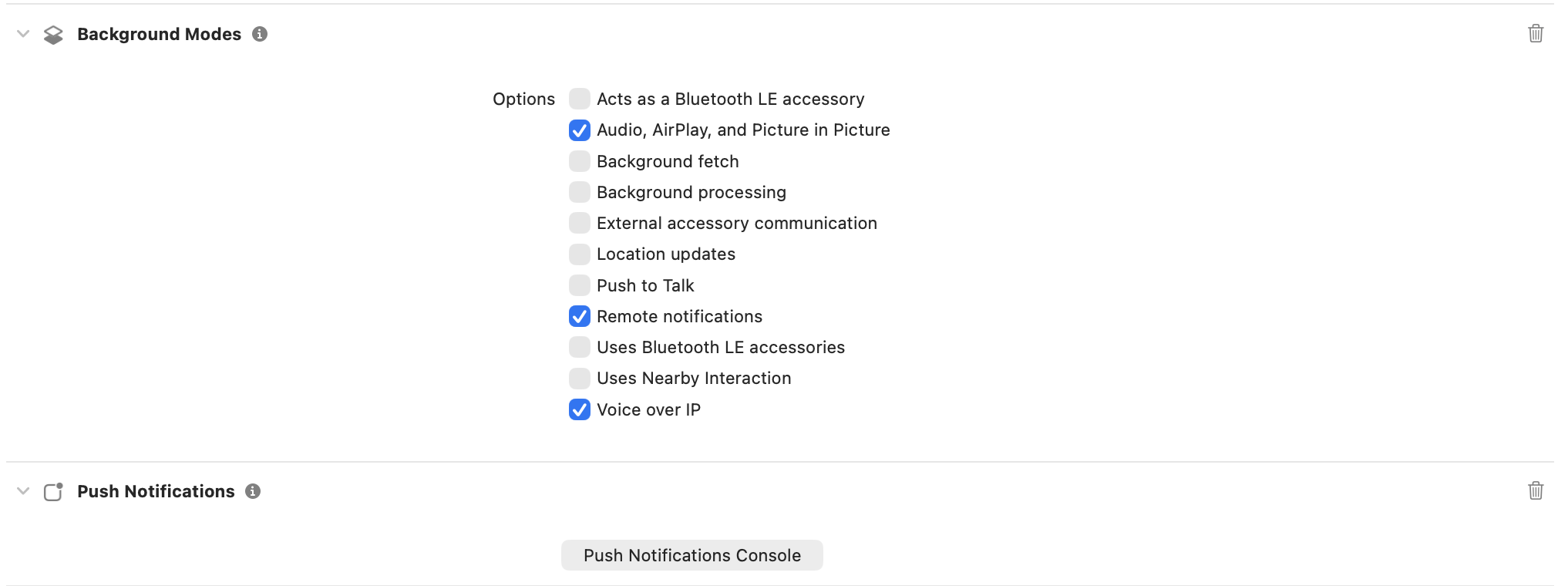
Enable Push Notifications and Background Modes for APNs

3. Local configuration

  • Update src/utils/AppConstants.tsx with appId, authKey, region, and apnProviderId.
  • Keep app.json name consistent with your bundle ID / applicationId.
const APP_ID = "";  
const AUTH_KEY = ""; 
const REGION = ""; 
const DEMO_UID = "cometchat-uid-1";

3.1 Dependencies snapshot (from Sample App)

Install these dependencies in your React Native app:
npm install \
    @cometchat/chat-sdk-react-native@4.0.18 \
    @cometchat/calls-sdk-react-native@4.4.0 \
    @cometchat/chat-uikit-react-native@5.2.6 \
    @notifee/react-native@9.1.8 \
    @react-native-async-storage/async-storage@2.2.0 \
    @react-native-community/push-notification-ios@1.12.0 \
    react-native-push-notification@8.1.1 \
    react-native-callkeep@4.3.16 \
    react-native-voip-push-notification@3.3.3
Match these or newer compatible versions in your app.

4. iOS setup

4.1 Project Setup

Enable Push Notifications and Background Modes (Remote notifications) in Xcode.
Enable Push Notifications

4.2 Install dependencies + pods

After running the npm install above, install pods from the ios directory:
cd ios
pod install

4.3 AppDelegate.swift modifications:

Add imports at the top:
import UserNotifications
import RNCPushNotificationIOS
Add UNUserNotificationCenterDelegate to the AppDelegate class declaration:
class AppDelegate: UIResponder, UIApplicationDelegate, UNUserNotificationCenterDelegate 
Add the following inside the didFinishLaunchingWithOptions method:
UNUserNotificationCenter.current().delegate = self

UNUserNotificationCenter.current().requestAuthorization(
    options: [.alert, .badge, .sound]
) {
    granted,
    error in
    if granted {
        DispatchQueue.main.async {
            application.registerForRemoteNotifications()
        }
    } else {
        print("Push Notification permission not granted: \(String(describing: error))")
    }
}
Add the following methods to handle push notification events:
func application(_ application: UIApplication, didRegisterForRemoteNotificationsWithDeviceToken deviceToken: Data) {
  print("APNs device token received: \(deviceToken)")
  RNCPushNotificationIOS.didRegisterForRemoteNotifications(withDeviceToken: deviceToken)
}

func application(_ application: UIApplication, didFailToRegisterForRemoteNotificationsWithError error: Error) {
  print("APNs registration failed: \(error)")
  RNCPushNotificationIOS.didFailToRegisterForRemoteNotificationsWithError(error)
}

func application(_ application: UIApplication, didReceiveRemoteNotification userInfo: [AnyHashable: Any], fetchCompletionHandler completionHandler: @escaping (UIBackgroundFetchResult) -> Void) {
  RNCPushNotificationIOS.didReceiveRemoteNotification(userInfo, fetchCompletionHandler: completionHandler)
}

func userNotificationCenter(_ center: UNUserNotificationCenter, willPresent notification: UNNotification, withCompletionHandler completionHandler: @escaping (UNNotificationPresentationOptions) -> Void) {
  completionHandler([.banner, .sound, .badge])
}
  
func userNotificationCenter(_ center: UNUserNotificationCenter, didReceive response: UNNotificationResponse, withCompletionHandler completionHandler: @escaping () -> Void) {
  RNCPushNotificationIOS.didReceive(response)
  completionHandler()
}
Add the following to Podfile to avoid framework linkage issues:
use_frameworks! :linkage => :static
You might have to remove below code if already present in your Podfile:
linkage = ENV['USE_FRAMEWORKS']
if linkage != nil
  Pod::UI.puts "Configuring Pod with #{linkage}ally linked Frameworks".green
  use_frameworks! :linkage => linkage.to_sym
end
Then lets install pods and open the workspace:
cd ios
pod install
open YourProjectName.xcworkspace

4.4 App.tsx modifications:

Import CometChatNotifications and PushNotificationIOS:
import { CometChat, CometChatNotifications } from "@cometchat/chat-sdk-react-native";
import PushNotificationIOS from "@react-native-community/push-notification-ios";
Get device token and store it in a ref: Also, define your APNs provider ID from the CometChat Dashboard. And request permissions on mount:
const APNS_PROVIDER_ID = 'YOUR_APNS_PROVIDER_ID'; // from CometChat Dashboard
const apnsTokenRef = useRef < string | null > (null);

useEffect(() => {
    if (Platform.OS !== 'ios') return;

    const onRegister = (deviceToken: string) => {
        console.log(' APNs device token captured:', deviceToken);
        apnsTokenRef.current = deviceToken;
    };

    PushNotificationIOS.addEventListener('register', onRegister);

    PushNotificationIOS.addEventListener('registrationError', error => {
        console.error(' APNs registration error:', error);
    });

    // Trigger permission + native registration
    PushNotificationIOS.requestPermissions().then(p =>
        console.log('Push permissions:', p),
    );

    return () => {
        PushNotificationIOS.removeEventListener('register');
        PushNotificationIOS.removeEventListener('registrationError');
    };
}, []);
After user login, register the APNs token:
//  Register token ONLY if we already have it
if (apnsTokenRef.current) {
    await CometChatNotifications.registerPushToken(
        apnsTokenRef.current,
        CometChatNotifications.PushPlatforms.APNS_REACT_NATIVE_DEVICE,
        APNS_PROVIDER_ID
    );
    console.log(' APNs token registered with CometChat');
}
Prior to logout, unregister the APNs token:
await CometChatNotifications.unregisterPushToken();

5. VoIP call notifications (iOS)

These steps are iOS-only—copy/paste and fill your IDs.

5.1 Enable capabilities in Xcode

  • Target ➜ Signing & Capabilities: add Push Notifications.
  • Add Background Modes → enable Voice over IP and Remote notifications.
  • Run on a real device (PushKit/CallKit don’t work on the simulator).

5.2 AppDelegate.swift (PushKit + CallKit bridge)

Update your AppDelegate to register for VoIP pushes ASAP and forward events to JS/CallKeep:
import PushKit
import RNVoipPushNotification
import RNCallKeep
// ...
@main
class AppDelegate: UIResponder, UIApplicationDelegate, UNUserNotificationCenterDelegate, PKPushRegistryDelegate {
  // ...
  func application(_ application: UIApplication, didFinishLaunchingWithOptions launchOptions: [UIApplication.LaunchOptionsKey: Any]? = nil) -> Bool {
    // existing UNUserNotificationCenter code ...
    RNVoipPushNotificationManager.voipRegistration() // triggers PushKit token
    return true
  }

  // APNs device token handlers stay unchanged

  // PushKit token -> JS
  func pushRegistry(_ registry: PKPushRegistry, didUpdate pushCredentials: PKPushCredentials, for type: PKPushType) {
    RNVoipPushNotificationManager.didUpdate(pushCredentials, forType: type.rawValue)
  }

  // Incoming VoIP push -> CallKit + JS
  func pushRegistry(_ registry: PKPushRegistry, didReceiveIncomingPushWith payload: PKPushPayload, for type: PKPushType, completion: @escaping () -> Void) {
    let dict = payload.dictionaryPayload
    let uuid = (dict["uuid"] as? String) ?? UUID().uuidString
    RNVoipPushNotificationManager.addCompletionHandler(uuid, completionHandler: completion)
    RNVoipPushNotificationManager.didReceiveIncomingPush(with: payload, forType: type.rawValue)
    RNCallKeep.reportNewIncomingCall(uuid, handle: (dict["handle"] as? String) ?? "Unknown", handleType: "generic", hasVideo: false, localizedCallerName: (dict["callerName"] as? String) ?? "Incoming Call", supportsHolding: true, supportsDTMF: true, supportsGrouping: true, supportsUngrouping: true, fromPushKit: true, payload: nil)
  }
}

5.3 Drop in VoipNotificationHandler.ts

Handles CallKeep UI, defers acceptance until login, and listens for PushKit events.
import { Platform } from "react-native";
import notifee, { AndroidImportance } from "@notifee/react-native";
import RNCallKeep, { IOptions } from "react-native-callkeep";
import { CometChat } from "@cometchat/chat-sdk-react-native";
import VoipPushNotification from "react-native-voip-push-notification";
import { setPendingAnsweredCall } from "./PendingCallManager";

const options: IOptions = {
  ios: { appName: "YourAppName" },
  android: { alertTitle: "VOIP required", alertDescription: "Allow phone account access", cancelButton: "Cancel", okButton: "OK", imageName: "ic_notification" },
};

type IncomingPayload = { sessionId?: string; senderName?: string; callerName?: string; name?: string; type?: string; [k: string]: any; };

class VoipNotificationHandler {
  channelId = "";
  isRinging = false;
  isAnswered = false;
  pendingAcceptance = false;
  callerId = "";
  msg: IncomingPayload | null = null;
  initialized = false;
  private setupPromise: Promise<void> | null = null;
  private listenersAttached = false;
  private lastSessionId: string | null = null;
  private lastRingAt = 0;

  async initialize() {
    if (this.initialized && this.setupPromise) { await this.setupPromise; return; }
    if (!this.setupPromise) {
      this.setupPromise = (async () => {
        if (Platform.OS === "android") { await this.createNotificationChannel(); }
        await this.setupCallKeep();
        this.setupEventListeners();
        this.initialized = true;
      })().catch(err => { this.setupPromise = null; throw err; });
    }
    await this.setupPromise;
  }

  private async setupCallKeep() {
    await RNCallKeep.setup(options);
    RNCallKeep.setAvailable(true);
    if (Platform.OS === "android") { RNCallKeep.setReachable(); }
  }

  private async createNotificationChannel() {
    this.channelId = await notifee.createChannel({ id: "message", name: "Messages", lights: true, vibration: true, importance: AndroidImportance.HIGH });
  }

  async displayIncomingCall(payload: IncomingPayload) {
    this.msg = payload || {};
    const sessionId = this.msg?.sessionId;
    const now = Date.now();
    if (sessionId && this.lastSessionId === sessionId && now - this.lastRingAt < 5000) return;
    if (this.isAnswered || this.pendingAcceptance) return;
    await this.initialize();

    const callerName = this.msg?.senderName || this.msg?.callerName || this.msg?.name || "Incoming Call";
    this.callerId = this.callerId || Math.random().toString();
    this.isRinging = true;

    await RNCallKeep.displayIncomingCall(this.callerId, callerName, callerName, "generic", true);
    this.lastSessionId = sessionId || null;
    this.lastRingAt = now;
  }

  onAnswerCall = async ({ callUUID }: { callUUID: string }) => {
    if (this.isAnswered) return;
    this.isRinging = false; this.isAnswered = true;
    const sessionID = this.msg?.sessionId; if (!sessionID) return;
    RNCallKeep.backToForeground();
    setTimeout(async () => {
      const loggedInUser = await CometChat.getLoggedinUser().catch(() => null);
      if (!loggedInUser) { this.pendingAcceptance = true; await setPendingAnsweredCall({ sessionId: sessionID, raw: this.msg, storedAt: Date.now() }); return; }
      try { await CometChat.acceptCall(sessionID); } catch (error: any) { if (error?.code !== "ERR_CALL_USER_ALREADY_JOINED") throw error; }
      RNCallKeep.endAllCalls(); this.pendingAcceptance = false;
    }, 350);
  };

  endCall = async ({ callUUID }: { callUUID: string }) => {
    const sessionID = this.msg?.sessionId;
    if (sessionID) {
      const loggedInUser = await CometChat.getLoggedinUser().catch(() => null);
      if (this.isAnswered) { await CometChat.endCall(sessionID).catch(() => {}); }
      else if (loggedInUser) { await CometChat.rejectCall(sessionID, CometChat.CALL_STATUS.REJECTED).catch(() => {}); }
    }
    const id = callUUID || this.callerId;
    if (id) RNCallKeep.endCall(id);
    RNCallKeep.endAllCalls();
    this.isRinging = false; this.isAnswered = false; this.pendingAcceptance = false; this.callerId = ""; this.msg = null; this.lastSessionId = null; this.lastRingAt = 0;
  };

  setupEventListeners() {
    if (this.listenersAttached) return;
    if (Platform.OS === "ios") {
      VoipPushNotification.addEventListener("notification", (notification: any) => this.displayIncomingCall(notification));
      VoipPushNotification.addEventListener("didLoadWithEvents", (events: any[]) => {
        (events || []).forEach(event => {
          if (event?.name === VoipPushNotification.RNVoipPushRemoteNotificationReceivedEvent) {
            this.displayIncomingCall(event.data);
          }
        });
      });
    }
    RNCallKeep.addEventListener("answerCall", this.onAnswerCall);
    RNCallKeep.addEventListener("endCall", this.endCall);
    RNCallKeep.addEventListener("didDisplayIncomingCall", ({ callUUID }) => { if (callUUID) this.callerId = callUUID; this.isRinging = true; });
    this.listenersAttached = true;
  }
}

export const voipHandler = new VoipNotificationHandler();

5.4 Add PendingCallManager.ts

Stores an answered call during cold start so you can accept it after login/navigation is ready.
import AsyncStorage from "@react-native-async-storage/async-storage";

export interface PendingAnsweredCallPayload { sessionId: string; raw: any; storedAt: number; }
let inMemoryPending: PendingAnsweredCallPayload | null = null;
const STORAGE_KEY = "pendingAnsweredCall";

export async function setPendingAnsweredCall(payload: PendingAnsweredCallPayload) {
  inMemoryPending = payload; try { await AsyncStorage.setItem(STORAGE_KEY, JSON.stringify(payload)); } catch {}
}

export async function consumePendingAnsweredCall(): Promise<PendingAnsweredCallPayload | null> {
  if (inMemoryPending) { const tmp = inMemoryPending; inMemoryPending = null; try { await AsyncStorage.removeItem(STORAGE_KEY); } catch {} return tmp; }
  try { const raw = await AsyncStorage.getItem(STORAGE_KEY); if (raw) { await AsyncStorage.removeItem(STORAGE_KEY); return JSON.parse(raw); } } catch {}
  return null;
}

export function isPendingStale(p: PendingAnsweredCallPayload, maxAgeMs = 2 * 60 * 1000) {
  return Date.now() - p.storedAt > maxAgeMs;
}

5.5 Wire App.tsx for APNs + VoIP token registration and handler init

import PushNotificationIOS from "@react-native-community/push-notification-ios";
import VoipPushNotification from "react-native-voip-push-notification";
import { voipHandler } from "./VoipNotificationHandler";
import { consumePendingAnsweredCall, isPendingStale } from "./PendingCallManager";

const APNS_PROVIDER_ID = "YOUR_APNS_PROVIDER_ID";
const APNS_VOIP_PROVIDER_ID = "YOUR_APNS_VOIP_PROVIDER_ID";

// Capture APNs device token
useEffect(() => {
  if (Platform.OS !== "ios") return;
  const onRegister = (deviceToken: string) => { apnsTokenRef.current = deviceToken; };
  PushNotificationIOS.addEventListener("register", onRegister);
  PushNotificationIOS.requestPermissions();
  return () => PushNotificationIOS.removeEventListener("register");
}, []);

// Capture VoIP token
useEffect(() => {
  if (Platform.OS !== "ios") return;
  const onVoipRegister = (token: string) => {
    CometChatNotifications.registerPushToken(
      token,
      CometChatNotifications.PushPlatforms.APNS_REACT_NATIVE_VOIP,
      APNS_VOIP_PROVIDER_ID
    ).catch(err => console.log("[VoIP] register failed", err));
  };
  VoipPushNotification.addEventListener("register", onVoipRegister);
  // token request is triggered in AppDelegate via RNVoipPushNotificationManager.voipRegistration()
  return () => VoipPushNotification.removeEventListener("register");
}, []);

// After login: register APNs token + init VoIP handler + consume pending accepts
useEffect(() => {
  const run = async () => {
    if (!loggedIn || Platform.OS !== "ios") return;
    const pending = await consumePendingAnsweredCall();
    if (pending && !isPendingStale(pending)) { await CometChat.acceptCall(pending.sessionId).catch(console.log); }
    const token = apnsTokenRef.current;
    if (token) {
      await CometChatNotifications.registerPushToken(
        token,
        CometChatNotifications.PushPlatforms.APNS_REACT_NATIVE_DEVICE,
        APNS_PROVIDER_ID
      );
    }
    await voipHandler.initialize();
  };
  run();
}, [loggedIn]);

5.6 VoIP push payload (APNs / PushKit)

Send a VoIP push with push_type=voip via APNs using a payload shaped like:
{
  "aps": { "alert": { "title": "Alice", "body": "Incoming call" }, "content-available": 1 },
  "sessionId": "<COMETCHAT_SESSION_ID>",
  "callerName": "Alice",
  "handle": "alice",
  "type": "call",
  "uuid": "<UUID>"
}

6. Handling notification taps and navigation

To handle notification taps and navigate to the appropriate chat screen, you need to set up handlers for both foreground and background notifications.

7. Testing checklist

  1. Install on device, log in, and verify APNs token registration success.
  2. Send a message from another user:
    • Foreground: banner shows unless that chat is open.
    • Background/terminated: tap opens the correct conversation; handler runs.
  3. VoIP: send PushKit VoIP push (payload above); expect CallKit incoming UI; answer and confirm CometChat call connects; end clears dialer.
  4. Rotate tokens (reinstall or revoke) and confirm onTokenRefresh re-registers.

8. Troubleshooting

SymptomQuick checks
No pushesConfirm APNs key uploaded, bundle ID matches, Push extension enabled with correct provider IDs, permissions granted.
Token registration failsEnsure registration runs after login, provider IDs are set, and registerForRemoteNotifications() is called.